
Skip to content

Drought

Drought Severity Increasing Across Watershed – Lake of the Woods Outflow Decrease on August 21

Since mid-May, drought conditions have steadily spread and increased in severity across the watershed. in response, the LWCB has directed gradual reductions in Lake of the Woods outflow over the summer. A further reduction is scheduled for Friday, August 21.

Drought Conditions

Total precipitation in May through July was well below normal across the region:
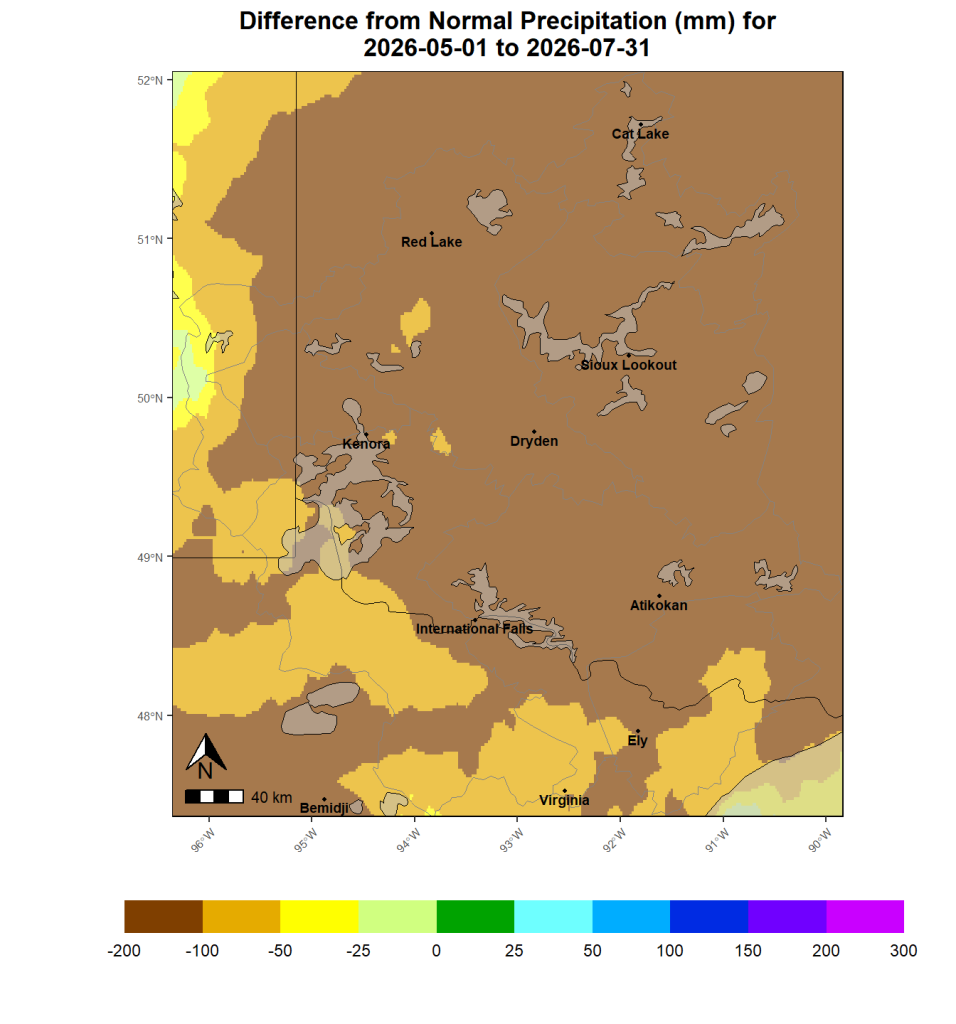
Data Source: Environment and Climate Change Canada, Regional Deterministic Precipitation Analysis

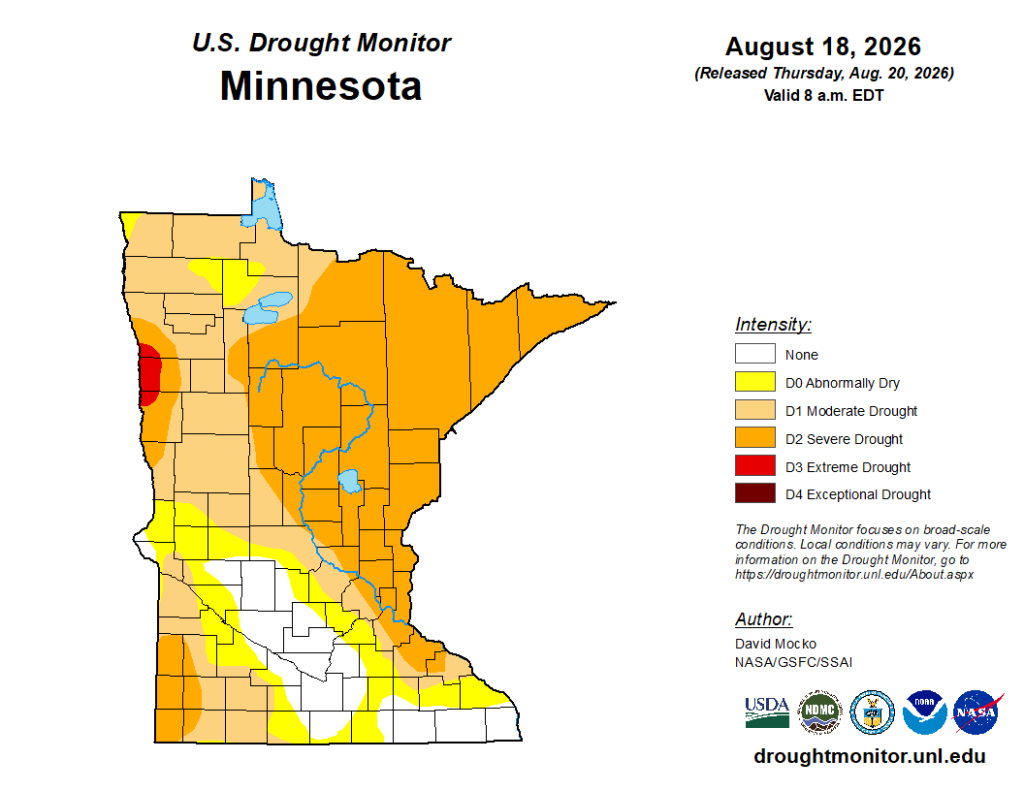
The August 18 Minnesota drought map from the United States Drought Monitor shows the entire Lake of the Woods watershed in Minnesota as being in either moderate drought (Lake of the Woods and lower Rainy River) or severe drought (Rainy Lake and upstream areas).
The most recent Canada Drought Monitor Map is from July 31 and shows the drought conditions extend across the Canadian portion of the Lake of the Woods watershed. The English River watershed is also in drought, with the central region showing a pocket of Extreme Drought developing.
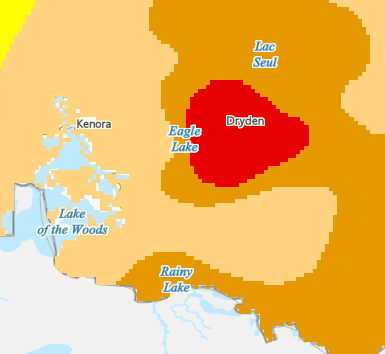
Canada Drought Monitor, July 31, 2026

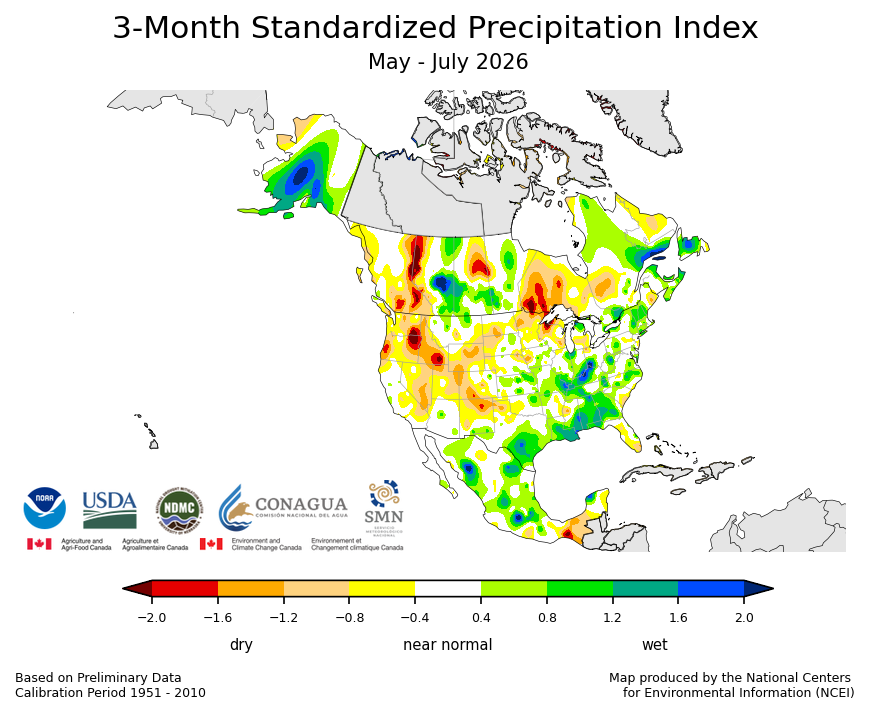
Another visualization of the change in conditions since early May is the Standardized Precipitation Index, produced by the North American Drought Monitor. Values below zero are related to drought conditions. All of the watershed is below zero with much of the watershed near negative 2, well below normal for this period, and one of the driest parts of North America compared to normal over this 3-month period.
Water Supply to Lake of the Woods

As a result of this worsening drought, flow in all tributaries in the Lake of the Woods watershed are below the 10th percentile (1-in-10 year low) for this time of year. Rainy Lake outflow, which is normally the largest source of water for Lake of the Woods, has been at the minimum allowed by the International Joint Commission since late June.

In August, daily inflow values to Lake of the Woods have been well below normal, with many daily values below zero. Negative inflow in late summer occurs under dry conditions due to evaporation from the lake. Under negative inflow conditions, the lake level would decline even with no outflow through the dams into the Winnipeg River. Current inflow is less than 5th percentile for late August, below a 1-in-20 year low.

Lake of the Woods Regulation Strategy for Low Inflow

The LWCB’s summer Regulation Strategy, adopted at Regulation Meeting in Kenora in June, lays out how the LWCB aims to balance conditions under low inflow conditions. The Secretariat has been implementing this strategy, making gradual cuts to outflow as the lake level has declined to balance the lake and river levels. The strategy includes lowering outflow to as low as 150 m³/s to prevent the lake from falling below 322.70 m (1058.73) through the end of September. The current level of Lake of the Woods is 322.75 m (1058.9 ft) and the rate of decline has been 3-4 cm (1-1.5 in) per week.

Lake of the Woods Outflow Reduction August 21 to 150 m³/s

Lake of the Woods authorized outflow will be reduced to from 200 to 150 m³/s on Friday, August 21 in line with the strategy. The level of the Winnipeg River below Norman Dam is expected to decline by about 7 cm (~ 3 in) as a result of this flow change, with smaller effects downstream. The river level at Minaki will not be affected by this flow change.

This flow reduction will slow but not stop the declining lake level. Substantial rainfall around Lake of the Woods and in the headwaters are needed to improve drought conditions, raise tributary flows, and provide sufficient inflow to Lake of the Woods to allow the lake level to rise again.

No Changes to Lac Seul Outflow

Despite drought conditions in the English River watershed, inflow to Lac Seul is at the lower end of the normal range for late August. This is due in large part to flows out of Lake St. Joseph into Lac Seul via the Root River Diversion.

The current level of Lac Seul is 356.31 m (1169.0 ft), a 30th percentile level for this time of year. The average lake level rose by 1.5 cm (~ 0.5 in) over the last week and is expected to change little over the next week. Lac Seul authorized outflow is 150 m³/s with no changes scheduled.

Issued 2021.09.23

The past week saw some much needed precipitation in a large portion of the Winnipeg River basin. According to the U.S. Drought Monitor, drought categories for some Minnesota portions of the basin improved from Exceptional to Extreme Drought or from Extreme to Severe Drought.

Data Source: Canadian Regional Deterministic Precipitation Analysis (RDPA)

However, due to the widespread drought conditions, little of this rainfall has reached streams and larger tributaries in the basin. Substantial rainfall is still needed to resolve the underlying drought conditions in the landscape and return flows to normal.

Water levels in key reservoirs upstream of Lake of the Woods, Rainy Lake and Namakan Lake, rose modestly but remain below regulatory targets set by the International Joint Commission. As a result, there has been no increase in the very low seasonal outflows from the dams at these lakes.

Flows in the Rainy River and its main tributaries, the Big Fork River and Little Fork River, saw very small responses to the rainfall. Inflow to Lake of the Woods has not increased significantly as a result.

Rainy River from International Falls, MN. Sep 22, 2021. Photo: Lee Grim

The current level of Lake of the Woods is 322.50 m (1058.1 ft), a 5th percentile level for this time of year. The lake level declined by 1 cm (1/2 in) over the past week and is expected to decline by 1-3 cm over the next week with forecasted dry weather. Lake of the Woods authorized outflow is 100 m³/s, with no outflow changes currently scheduled.

In the English River basin, the rainfall led to a greater rise in tributary flows in some areas, for example near Sioux Lookout and the Chukuni River where flows are now in the normal range for late September. Other tributaries remain well below normal, as does the level of Lac Seul and the mainstem of the English River as measured at Grassy Narrows.

The current level of Lac Seul is 355.62 m (1166.7 ft), less than 5th percentile for this time of year. The lake level rose by 6 cm (2 in) over the past week and is expected to rise by 1-3 cm (1 in) over the next week. Lac Seul authorized outflow is 75 m³/s with no changes currently scheduled. A planned regional power outage scheduled by Hydro One will result in fluctuations in outflow from Lac Seul on September 26 and 27, varying between 39 and 107 m³/s before returning to the authorized 75 m³/s.

Issued 2021.08.12

The past week saw some precipitation across the basin, with the greatest amounts near the English River downstream of Lac Seul.

7-day precipitation as of August 11, 2021. Data from the Regional Deterministic Precipitation Analysis (RDPA) by Environment and Climate Change Canada.

Across the entire Winnipeg River watershed, however, drought conditions remain. The July 31 classification of drought by the North American Drought Monitor shows the entire watershed as either in severe or extreme drought. The latest update (August 12) from the U.S. Drought Monitor shows a swath of the Rainy River watershed now in the Exceptional Drought category.

Precipitation statistics from NOAA indicate that county-wide precipitation for Lake of the Woods and Koochiching counties in Minnesota were the lowest on record for July, June-July, and May-July. Records date back to 1897.

Lake of the Woods County, MN precipitation statistics May-July 2021
Source: https://www.ncdc.noaa.gov/cag/county/rankings/MN-077/pcp/202107

The LWCB’s watershed-wide statistics mirror this data.

Low flows and water levels persist across the watershed. Natural (undammed and unregulated) rivers are exceptionally low as are inflows to Lake of the Woods and Lac Seul. The Big Fork River and Little Fork River, key tributaries to Rainy River and Lake of the Woods, set new calendar day low flow records several times over the past few weeks, with record-keeping there by the USGS dating back over 100 years.

LWCB regulation of outflows from Lac Seul and Lake of the Woods and flows along the Winnipeg and English Rivers in Ontario is being carried out according the low flow scenarios in the adopted Regulation Strategy. With the ongoing drought conditions, the primary focus remains on conserving water in these lakes for future river supply.

The current level of Lake of the Woods is 322.55 m (1058.2 ft), a 10th percentile level for this time of year. The average lake level fell by 2 cm (1 in) over the past week and is expected to decline by 1-2 cm (1 in) over the next week.

Lake of the Woods authorized outflow is 130 m3/s.  A reduction in outflow, to 120 m³/s, is scheduled for Monday, August 16. The Winnipeg River immediately below the Norman Dam is expected to decline by 1-2 cm (1 in ) as a result of this flow reduction.

The current level of Lac Seul is 355.50 m (1166.3 ft), a 5th percentile level for this time of year. The average lake level rose by 4 cm (2 in) over the past week and is expected to rise by 1-2 cm (1 in) over the next week.

Lac Seul authorized outflow is 60 m3/s. No changes to outflow from Lac Seul are currently scheduled.